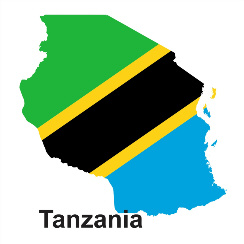
Indepenedence day
9 December
Late in 1961, the predecessor state of Tanganyika was established through the Tanganyika Independence Act of 1961. This act ended British rule and established self-government.[65] A new republican constitution was adopted one year later, in December of 1962. This abolished the remaining role of the British monarchy in Tanganyika. A union with the neighboring state of Zanzibar in 1964 led to the formation of the Republic of Tanzania.
Late in 1961, the predecessor state of Tanganyika was established through the Tanganyika Independence Act of 1961. This act ended British rule and established self-government.[65] A new republican constitution was adopted one year later, in December of 1962. This abolished the remaining role of the British monarchy in Tanganyika. A union with the neighboring state of Zanzibar in 1964 led to the formation of the Republic of Tanzania.
Tanzania’s independence campaign began in 1954, and Julius K. Nyerere, co-founder of TANU Tanganyika African National Union], was at the helm. He was trained in Scotland and Uganda, and when he returned home from Uganda, he began speaking his anti-colonialist ideas\Africanist political ideology. He was motivated by Mahatma Gandhi’s nonviolent freedom struggle in India and called for a similar campaign in Tanganyika. He played a key role in bringing together different tribal groupings across the region to form a united force against Great Britain until Tanzania’s Independence day.
Nyerere, recognized as a teacher or Swahili for ‘’Mwalimu’’ due to his teaching background, was nominated to the General Assembly in the general elections of 1958–1959 and became the 1st Head of State of a free Tanganyika in 1961. After overthrowing the Ruler of Zanzibar, it established a Republic the following year and joined with Zanzibar at the beginning of 1964. That’s when the nation’s name was changed to Tanzania.
He also was a socialist who established state-owned service programs and community-owned farm policies. He would become the first African ruler to voluntarily step down from office after his plans to make Tanzania self-sufficient failed. Because of his moral principles, he is still regarded as a respected personality in the region for his role in the Tanzania Independence day.
In fact, the governing party, ”Chama Cha Mapinduzi,” is a continuation of TANU, which combined with the Afro-Shirazi political party of Zanzibar to form the country’s only ruling party. The majority of the Zanzibar islands is currently a semi-independent province of Tanzania, with a banner that is a version of Tanzania’s flag.
1919 Britain takes over Tanganyika.
Tanzania’s region had been under German authority since the late 1900s, and following the Versailles treaty, it was handed down to the United Kingdom, Portugal, and Belgium.
1954 Tanzania’s Independence Day Campaign is born.
After Julius Nyerere’s endeavors to unite the region’s diverse tribes flourished, the TANU [Tanganyika African National Union] was created to fight for full sovereignty.
1959 TANU Establishes its Government Under British Rule
TANU wins all of its seats in the 1958–1959 general elections. It is deservedly on its way to demanding independence from the United Kingdom, which is granted shortly after.
Tanganyika Became Tanzania
The Zanzibar Revolt of 1964 deposed the Sultan and his predominantly Arabic government, and the country acquired its current name when it unified with Tanganyika.