Indepenedence day
23 April
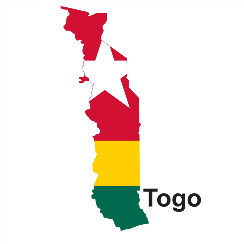
Togo, officially the Togolese Republic, is a country in West Africa. It is bordered by Ghana to the west, Benin to the east and Burkina Faso to the north. It extends south to the Gulf of Guinea, where its capital, Lomé, is located. It covers about 57,000 square kilometres (22,000 square miles) with a population of approximately 8 million, and has a width of less than 115 km (71 mi) between Ghana and its eastern neighbor Benin.
From the 11th to the 16th century, tribes entered the region from various directions. From the 16th century to the 18th century, the coastal region was a trading center for Europeans to purchase slaves, earning Togo and the surrounding region the name "The Slave Coast". In 1884, Germany declared a region including a protectorate called Togoland. After World War I, rule over Togo was transferred to France. Togo gained its independence from France in 1960. In 1967, Gnassingbé Eyadéma led a successful military coup d'état, after which he became president of an anti-communist, single-party state. Eventually, in 1993, Eyadéma faced multiparty elections which were marred by irregularities, and won the presidency 3 times. At the time of his death, Eyadéma was the "longest-serving leader in modern African history", having been president for 38 years. In 2005, his son Faure Gnassingbé was elected president, and continues to hold the office as of 2022.
Togo is a tropical, sub-Saharan nation whose economy depends mostly on agriculture. While the official language is French; other languages are spoken, particularly those of the Gbe family. The largest religious group is Christian (47.8%) with the second largest being those with indigenous beliefs. There is a significant Muslim minority. Togo is a member of the United Nations, African Union, Organisation of Islamic Cooperation, South Atlantic Peace and Cooperation Zone, Francophonie, Commonwealth, and Economic Community of West African States.